
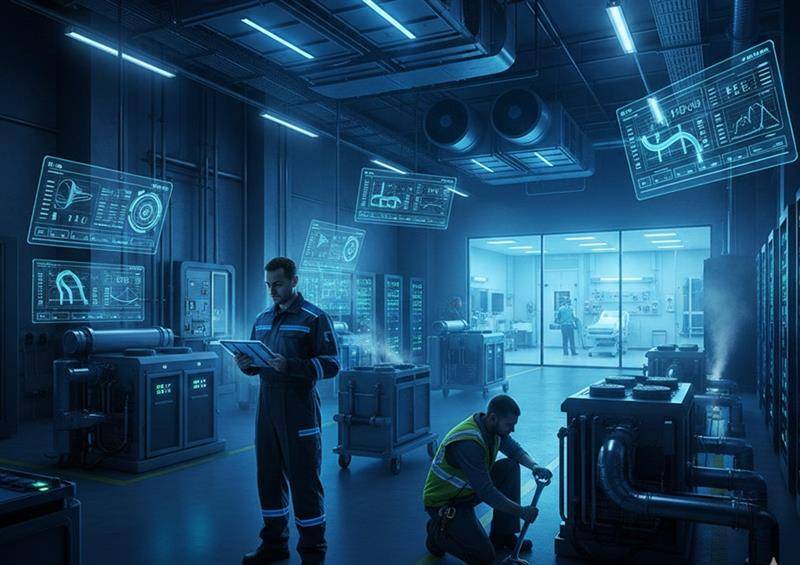
Night-Ready HVAC Emergency Strategies for 24/7 Commercial Facilities
The 24/7 operations of warehouses, hospitals, hotels, and data centres face the special hazards of HVAC emergency due to failures that take place out of hours with no daytime innovative provisions. Preparedness planning is important to ensure prompt reaction, containment as well as restoration as well as protecting revenue, safety and compliance. Strategies such as redundancy, practice of the protocol, partnering with the vendor and monitoring effectively combine these to turn the disaster into manageable occurrences.
Building Redundancies and Backup Capacity
HVAC systems that are resilient are needed in night operations. Dual chillers or modular air handlers give immediate fail over and isolate fault without a full stop. Backup boilers fill interim gaps in cooling in case of compressor work, mobile spot units are used temporarily to furnish areas.
Tiered redundancy is in line with criticality, primary systems will be used to serve patient wing and server halls whereas secondary will serve corridors. The annualload testing is to ensure that backup is capable of supporting peak nightly loads. In case of power outages, battery backups are used to run power off controls and fans to avoid a cascade failure. Facilities locate their no-fails and overcapacity in those areas.
Rentals by the vendor, which consist of chillers with four-hour backup, offers more opportunities in case of long outages. Frequent cross-training gives in-house units the ability to substitute easily modular units. This defensive stratification purchases vital response time at night when it is time to be critical.
Developing 24/7 Response Protocols
ERT charters specify the night specific functions: lead technician, safety officer and communications liaison. The responses can be divided into segments on basis of failure type- refrigerant leak (evacuate/contain), fan failure (bypass/ventilate), sensor fault (manual override).
Periodic drills (quarterly), simulating conditions of midnight, have a time period between alarm and stabilization time to thirty minutes. Isolation is used by checklists damper closures, unit shutdowns, and airflow rerouting. The manual overrides are given the priority in night protocols as BAS do not have IT support.
Communication trees will work immediately: cascades of text to on-call staff, vendor messages will involve system specifications, and tenant messages will take place through mobile applications. The process of escalation ladders informs executives whether the downtime is on limits (in the case of hospitals, cooling loss of fifteen minutes). Debriefs after the drills perfect timing and gaps. Drilled performance downplay panic and mistakes.
Vendor Partnerships and Service Level Agreements
Priority contracts give night emergency ETAs that are two-hour, processed by-passing queues. SLAs give the stocked parts of frequent failures, such as compressors, coils, actuators, etc., and ensure 24/7 delivery.
Pre-audits make vendors conversant with layouts of sites, rooftop access and strategic areas. Tabletop analyses of coordination: an annual simulation of chiller failure at two a.m. With many vendors, the coordination is tested with no single-point failure.
Bonuses are based on incentives that encourage uptimes, and penalties that impose response times. After-hours gate codes and escorts are availed in the facilities to enhance access. Reliable partners are considered to be part of internal teams and thus they make operations faster at night.
Monitoring, Prediction, and Post-Recovery
BAS incorporates a refrigerant pressure sensor, coil-temperature sensor and airflow anomaly sensor to effectively warn of failure prior to complete failure. Issues caused by the vibration spikes or efficiency drop are predicted by CMMS trends. Night dashboards are used to identify preemptive checks as yellow warnings.
Predictive models are fed on root-cause audits based on events and on identifying patterns that had been overlooked during manual preparation that occur during the day.
Test full restoration, recalibrate loads and also document results to insurance. Lessons refresh the protocols; near misses initiate brief exercises. The monitoring at all days bridges the gap between prevention and perfection.
Night time operating facilities are the products of stratified HVAC endurance. The layoffs save time; protocols work perfectly; the vendors react in real-time; monitoring eliminates failures completely. This blueprint protects the 24/7 reliability.