
Commercial HVAC Seasonal Maintenance Checklist: Essential Tips for Facility Managers
In the high-stress environment of office building operation, a sound HVAC system ensures that personnel will be comfortable, that energy-saving measures will be implemented, and that the safety of all occupants in buildings will be observed in offices, shopping centers, and even warehouses. These systems fall in pressure of heavy seasonal conditions such as scorching days in the summer and freezing days in winter thus requiring aggressive maintenance to avoid an expensive breakdown. The lack of maintenance leads to the development of the high cost of repair and operational inconveniences as well as the risk of health risk due to poor air flow. The experts note that seasonal inspections lead to a thirty percent increase in equipment life, ten to twenty percent less in energy spent, and avoidance of crises during the peak season, which makes this acknowledgment mandatory in the population of facilities teams employees.
Why Seasonal HVAC Maintenance is Essential
The type of commercial HVAC systems must be able to achieve high-volume requirements in a variety of spaces with the dust accumulation and wear rapidly diminishing the performance. Spring and fall tune-ups address weaknesses before harsh weather hits, thus, repairing high level performance. By preventing breakdowns, property managers save a lot of money, whereas cleaner systems improve the indoor air quality and make buildings up to the building codes. Energy optimization saves utility bills, helps in green and routine maintenance increases the life of high cost assets like chillers and boilers. When teams follow some kinds of plans, the number of disruptions in services is much lower and this proves that pre-emptive maintenance is much better than reactive interventions.
Spring and Summer Cooling Preparations
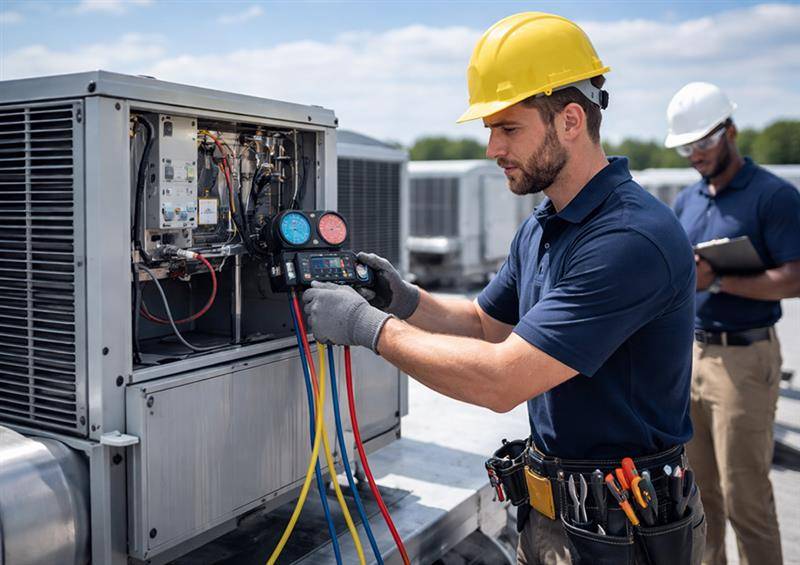
In the moderate climate, it should take no more than the beginning of April (representing the spring) before the technicians begin the cooling season by focusing on airflow, refrigerant integrity, and outdoor resilience against pollen and grime. It is started by cleaning evaporator and condenser coils with care to get out efficiency-destroying dirt that can not only cripple its performance by twenty or thirty percent but also over-strain compressors. Afterwards, the contents of refrigerants are checked using leak detectors since inadequacy paralyzes the cooling. The belts, motors, bearing are inspected on cracks or vibration and lubricated accordingly to help in reducing noise and friction. High-MERV units are installed in the place of suspended filters to protect the blowers and clean air. The thermostats and controls are adjusted to ultra-specific, occupancy-sensitive scheduling, the condensate drains are forced to empty to prevent stagnation of water, the outside units are trimmed with the help of clipping the foliage and adjusting the fans. Lastly, leaks in ducts are closed and the duct sections are cleared to provide clear passage of air and measurements of pressures and temperatures recorded as benchmarks.
Fall and Winter Heating Preparations
Fall tune ups are done in readiness to winter chill and safe heating is made a priority between September and October to avoid during mid season crises. The analytical tools are used to check the heat exchangers and burners against cracks, soot, or rust because defects lead to carbon-monoxide hazards. Ignition sensors, limit switches and pressure controls are checked with perfect functionality, and then the flawless work of fuel lines and valves in gas or oil models is checked. Deflection of blowers is done and lubricated on areas of heat distribution to ensure that vents are not blocked to allow proper exhaust. Filters and coils are cleaned, thermostats are re-adjusted to heating standards, in case of boilers, radiators are bled and, of course, water levels are monitored, and pumps are checked. There are weekly winter checks and upkeep of the running monitors.
Year-Round Preventive Care Strategies
Along with seasonal factors, regular routines enhance HVAC then-and youth, such as replacement of filters one or three times a month relative to usage and clearance of rooftops and mechanical rooms and software to track the HVAC run-time, energy consumption, and alerts. Higher diagnostics like thermography are supplied by certified professionals biannually, the necessary means are available like belts and fuses, employees are trained on resets. CMMS is standardizing multi-site efforts with digital logs storing warranty proofs, audit trails, and claims data.
Crafting a Tailored Maintenance Blueprint
A customized maintenance plan is developed by fitting the checklist to local situations- accurate zoning of offices, high air-change rate in warehouses, or sterile filtration in healthcare as the maintenance planning begins with evaluation of equipment age, load and locale. It should be considered working with neutral contractors and to achieve this, one to two percent of system value should be allocated annually and an audit conducted and the frequency of calls per annum decreased as a measure of success.
Through implementing a seasonal HVAC repair checklist, the commercial management switches the crisis mode to active mastery, which provides longevity to comfort, financial gain, and stability. Begin your spring work now, and have lasting profits.