Introduction
If you manage a commercial building, your HVAC repair bills tell a story.
The problem is that most property owners look at those invoices individually. One capacitor here, a blower motor there, another emergency service call during the hottest week of the year.
Look at the same bills together over 12 months, however, and patterns start to appear.
Why Your Repair History Matters
Your service invoices are more than accounting records. They can help you understand:
- Which equipment is failing most often
- Which components are consuming your repair budget
- How frequently emergency calls occur
- Whether the same problem keeps returning
- Whether maintenance is preventing failures
- Which systems may need replacement planning
If you have not reviewed your HVAC history recently, the last 12 months is a good place to start.
What Your Last 12 Months of HVAC Repair Bills Can Tell You About Your Maintenance Plan
1. Frequent Repairs May Mean Your Maintenance Plan Needs Attention
There is no universal answer to how often should commercial HVAC be repaired.
If your records show several repairs on the same unit, ask:
Of there is a record of multiple repair on same HVAC unit then you must ask:
Why is it happening again?
For example:
- The same blower motor has failed twice.
- A rooftop unit repeatedly develops electrical faults.
- Refrigerant-related issues keep appearing.
- Drain blockages are becoming regular service calls.
- The same thermostat or sensor keeps being replaced.
These patterns deserve investigation rather than another isolated repair.
2. Look at Which Units Cost You the Most
Add up the HVAC repair costs for each major piece of equipment.
You may discover that one rooftop unit is responsible for a surprisingly large percentage of your annual repair budget.
Create a simple record showing:
| Equipment | Repairs | Repair Cost | Emergency Calls |
|---|---|---|---|
| RTU-1 | 2 | $X | 0 |
| RTU-2 | 6 | $X | 3 |
| RTU-3 | 1 | $X | 0 |
3. Emergency Calls Reveal Weaknesses in Your Plan
A maintenance program should not only respond but reduce the surprises
Look through your invoices and count:
- After-hours calls
- Weekend repairs
- Emergency breakdowns
- Repeated no-cooling/no-heating complaints
- Temporary repairs
- Call-backs after previous service
If there is emergency work more frequently then HVAC maintenance plan need to be more proactive.
4. Small Repairs Can Reveal Bigger Problems
Not every repair bill means the equipment is failing.
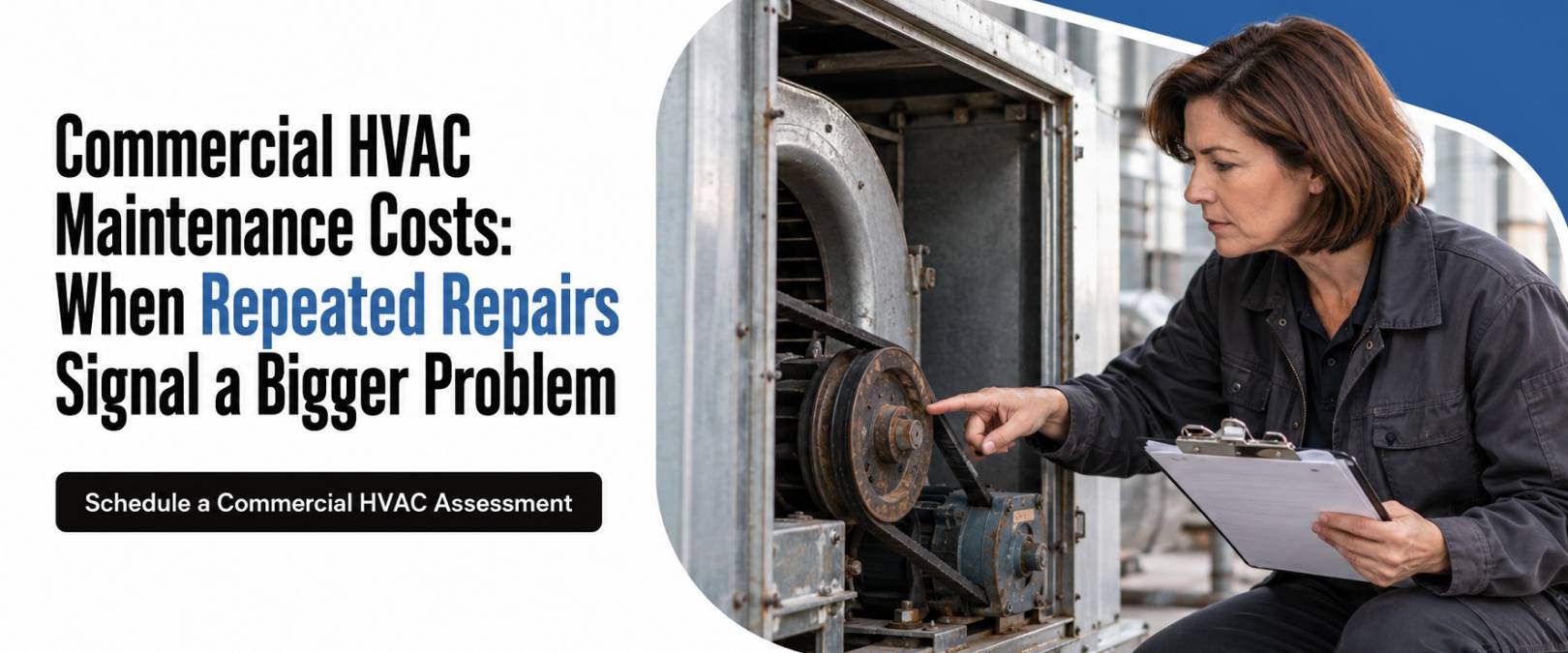
Repeated belt problems
Could indicate alignment, tension or mechanical issues rather than simply requiring another belt.
Repeated drain problems
Could suggest inadequate cleaning, drainage design problems or recurring condensate issues.
Repeated electrical failures
It may require the check-up of connection, motor, capacitor, controls, and other components related to electricity.
5. Compare Repair Bills With Maintenance Expenses
This is where your records become particularly useful.
Add together your annual:
Preventive maintenance expenses + repair costs + emergency service costs
Then compare that with what you actually received from your maintenance program.
A maintenance contract that produces regular inspections but does not identify developing problems may need to be reviewed.
Ask:
- Are technicians documenting equipment condition?
- Are recurring problems being tracked?
- Are performance readings being recorded?
- Are recommended repairs being followed up?
- Is the maintenance schedule adjusted for equipment age and usage?
Good maintenance is not simply about performing visits. It is about using those visits to improve reliability over time.
6. Your Repair Bills Can Help Build Next Year’s Budget
Your 12-month history can also make HVAC budgeting more realistic.
Instead of simply carrying last year’s maintenance budget forward, separate your spending into:
Routine maintenance
- Inspections
- Filter service
- Coil cleaning
- Lubrication where applicable
- Controls checks
- Preventive adjustments
Planned repairs
- Worn belts
- Aging motors
- Electrical components
- Damaged controls
- Drainage issues
Emergency repairs
- Major component failures
- Unexpected breakdowns
- After-hours service
Capital planning
- Major equipment replacement
- System upgrades
- Controls modernization
- Efficiency improvements
This gives facility managers a clearer picture of where their HVAC maintenance expenses are actually going.
7. Check Whether Maintenance Is Based on the Equipment
A common mistake is using exactly the same maintenance schedule for every HVAC unit.
A 20-year-old rooftop unit running long hours in a heavily occupied building may require a different approach from newer equipment with lighter usage.
Your maintenance plan should consider:
- Equipment age
- Manufacturer recommendations
- Operating hours
- Building occupancy
- Seasonal demand
- Previous failures
- Indoor environmental conditions
- Equipment criticality
8. Know When Repairs Are No Longer the Best Strategy
A long list of repair invoices does not automatically mean replacement is necessary.
But repeated failures should trigger a closer review.
Consider an equipment assessment when:
- Repair frequency is increasing
- Major components are failing repeatedly
- Parts are becoming difficult to source
- Comfort complaints continue after repairs
- Energy performance is declining
- Repair costs are becoming difficult to justify
- The equipment is approaching the end of its expected service life
The goal is not to replace equipment simply because it has required repairs. It is to avoid continuing an expensive cycle without understanding why failures are occurring.
A Simple 12-Month HVAC Review
Before creating next year’s commercial HVAC maintenance budget, review your previous 12 months and ask:
Equipment
- Which units required the most repairs?
- Which components failed repeatedly?
Costs
- How much went toward routine maintenance?
- How much went toward repairs?
- How much was spent on emergency calls?
Performance
- Were comfort complaints increasing?
- Did energy consumption change?
- Were there recurring operational problems?
Planning
- Which repairs should be completed proactively?
- Which equipment needs closer monitoring?
- Which units should be considered for future replacement?
Conclusion
Your HVAC repair bills are not just expenses. They are useful maintenance data.
When reviewed together, they can show whether your current HVAC maintenance plan is preventing problems, simply reacting to them, or missing recurring issues altogether.
The objective of commercial HVAC maintenance should not be to eliminate every repair. Equipment will eventually wear out.