Introduction
For commercial property owners and facility managers, HVAC spending can feel unpredictable when repairs are handled only after something breaks.
The cost and total expenditure can be unpredictable for large scale business owners and facility managers. Encountering minor issues in every few months is not a big deal. But repeated issues with more frequency in faults can exceed the budget. A failed motor, gas level issues, or system shutdown can be some expensive and unpredictable issues.
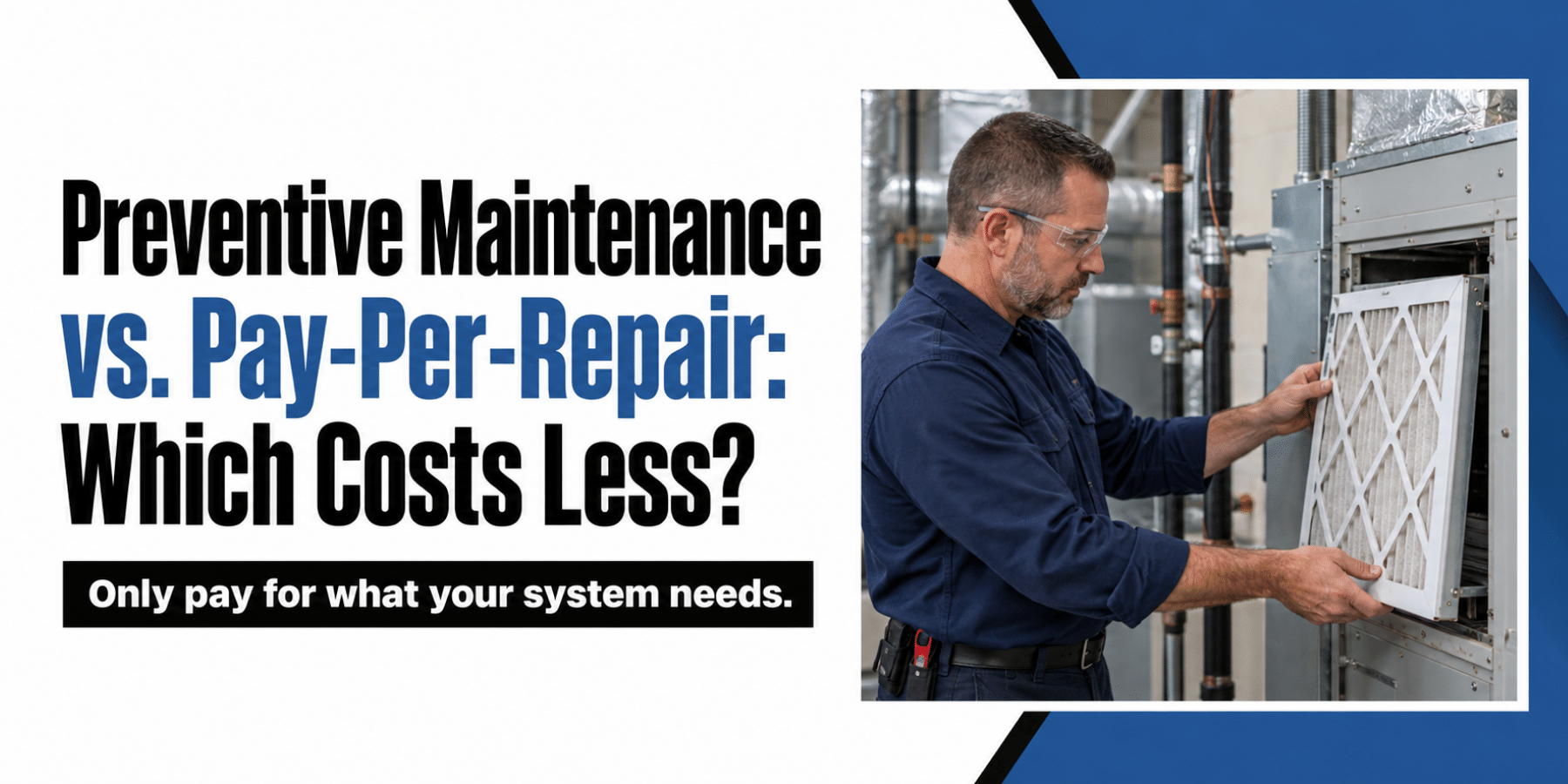
That is the main difference between preventive maintenance vs repair: one is designed to detect the issue in its early stages and other means you have to pay for the issue that already harmed the system or its components.
Choosing the better option is you call. Either schedule regular maintenance or pay for the delayed repairs.
What Is an HVAC Preventive Maintenance Plan?
An HVAC preventive maintenance plan is scheduled service yearly or twice a year. It is conducted ny HVAC service providers to keep the system working smoothly and detect the early faults.
As per the type of the system, a plan may include:
- Filter inspections and replacement
- Coil cleaning
- Electrical checks
- Belt and motor inspections
- Thermostat and control checks
- Refrigerant and drainage inspections
- Airflow and performance testing
- Documentation of equipment condition
The HVAC maintenance sessi should be based on equipment type, usage type, and operating conditions.
What Does Pay-Per-Repair Really Cost?
Pay-per-repair is a service you take from HVAC professionals when something goes wrong in a specific part of HVAC system.
It may look cheap and budget friendly than maintenance plans, but actually breakdown of costs tells each repair is more costly than a one time maintenance plan that makes sure no repair is needed till a particular period.
Here’s a complete breakdown of the kind of charges:
- Diagnostic and service-call charges
- Parts and labor
- Extra hours or emergency service
- Expedited parts
- Business or tenant disruption
- Lost productivity
- Possible secondary equipment damage
- Unusual noise or vibration
- System performance
- Visible corrosion or damage
Reactive, or run-to-failure, maintenance can be appropriate for equipment where failure has little consequence and replacement is inexpensive. For critical commercial HVAC equipment, however, unplanned downtime can carry a much higher overall cost.
HVAC Maintenance Cost: Why There Is No Fixed Number
There is no universal price for commercial HVAC maintenance.
The HVAC maintenance cost can depend on:
- Number of HVAC units
- Equipment type and size
- Building size
- System age and condition
- Accessibility of equipment
- Service frequency
- Operating hours
- Required inspections and testing
That’s the reason why it is not acceptable to compare the maintenance plan price and the price of one repair. For comparison, consider the over time operational cost of an equipment that must include energy consumption, repair sessions, and replacement. The maintenance cost can vary depending on various factors like size of system, amount of usage, complexity, location, configuration, and requirements.
The Hidden Cost of Waiting for Something to Break
Imagine two rooftop units.
One receives regular inspections. While scheduled maintenance is running on the system, the technician notices small issues and on-time fixes it.
The second unit receives service only after it fails.
The failed unit may require an urgent call, unexpected labor, immediate parts, and downtime while the repair is completed.
The first repair still costs money. The preventive maintenance does not fix the errors out of nowhere.
But it always provide business owners and facility managers time to think and plan.
That difference matters.
When Does a Preventive Plan Make the Most Sense?
HVAC maintenance plans for commercial buildings are particularly useful when:
- HVAC equipment is critical to daily operations.
- The property has multiple units or locations.
- Tenant comfort is a priority.
- Unexpected downtime would be expensive.
- Equipment is aging.
- Facility managers require budget overview for maintenance.
It is reasonable to pay for repairs of small, non-complex equipment.
The strategy should match the consequences of failure—not just the lowest upfront price.
How to Find Affordable Commercial HVAC Maintenance
Affordability does not mean finding the cheapest maintenance plan providers in the town.
A useful plan should clearly explain:
- What equipment is covered
- How often visits are scheduled
- What tasks are included
- How findings are documented
- How repair recommendations are handled
- What services cost extra
Ask for a plan tailored to your building rather than paying for unnecessary visits or services that don’t match your equipment.
Conclusion
The real question isn’t simply, “Is a maintenance plan cheaper than a repair?”
A better question is: What is the cost of unexpected HVAC failure?
A pay-per-repair may look like lower cost solutions, but it renders budget exposed to upcoming system breakdowns.
A preventive plan involves scheduled spending, regular inspections, and earlier identification of developing problems.
For many commercial properties, the most practical approach is not maintenance instead of repairs. It is proper preventive maintenance plan that reduces the repair chances and provide a clear overview of equipment condition to the one who handles it.