Hard Water Minerals: Long-Term Damage to Commercial Plumbing Systems
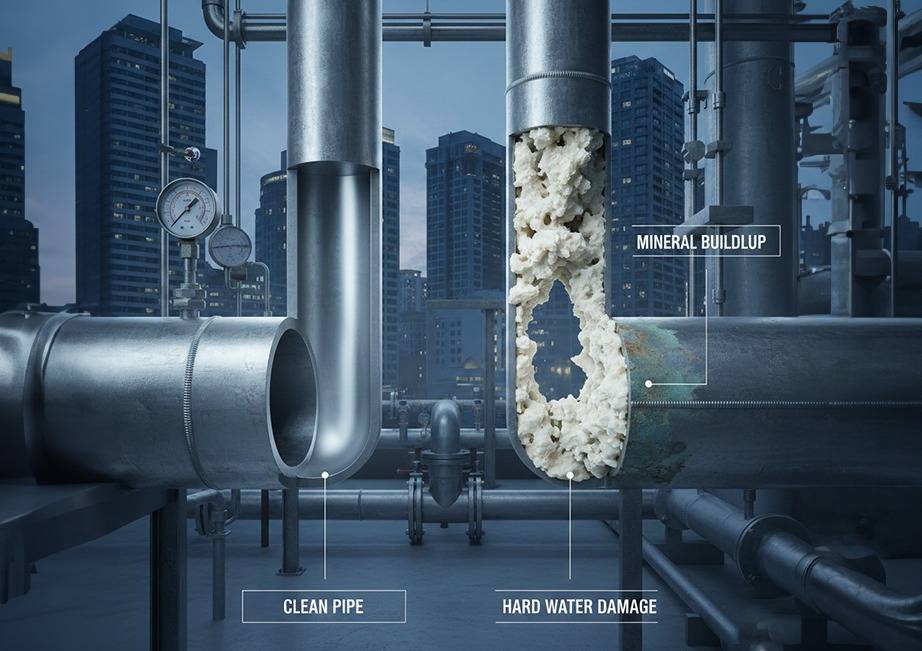
Long-term risks to commercial plumbing infrastructures include calcium, magnesium, and various other hard water mineral deposits and may manifest itself as office tower, hotels, and manufacturing facilities. The dissolved ions deposit as limescale on the inside of pipes, fixtures and equipment, gradually reducing the flow rate, accelerating wear and swelling the operating cost. When uncontrolled accumulation of minerals develop in high-volume settings, they result in key maintenance issues and a super early breakdown of the systems.
Scale Buildup Restricts Flow and Pressure
As water flows down the commercial risers and laterals, minerals as chalky calcium carbonate deposits develop sticking to the inside of the pipes. Over time, this limescale whittles down the pipe sizes and the pressure of water to those further down the pipe to fixtures and outlets. In multi-story buildings, the worst appears in high-rise buildings, where the low flow in lavatories, showers and process equipment is affected.
Clogged valves and aerators make the problem more serious and lead to the higher load on the pumps and high energy consumption. Finally, limitations become extreme causing overload in drainage stacks, particularly during peak occupancy. Commercial scale means that hundreds of fixtures are impacted at once, which enhances downtime and urgency of repair, unlike residential.
Accelerated Corrosion and Pipe Failure
Mineral scale does not simply clog, but it traps moisture and forms galvanic cells, which corrode metal pipes, especially copper and galvanized steel. Calcium carbonate is an abrasive that wears the edges of the pipes when turbulent flow occurs and will result in pinholes. Scale creates additional problems in hot water loops where thin walls rupture as a result of under shoot corrosion.
The dissimilar alloys increase the risk in mixed-metal systems, and the alloys hasten the onset of the electrolytic attack. Large-scale leaks result in the loss of major incidents within commercial facilities, with leaks overflowing into server rooms or production areas and necessitating emergency closings. Scale also takes hold of shut-off valves which makes it difficult to isolate them when repairing.
Water Heater and HVAC Efficiency Losses
The greatest victims of mineral insulation on heating elements are commercial boilers and tankless heaters. Scale is a resistant barrier pushing units to operate longer at a cost of up to 30 per cent of energy in extreme spikes. The elements become overheated and fuse prematurely and the anodes corrode more rapidly in the absence of water softening.
The HVAC chillers and cooling towers have threats that are the same, and heat exchangers and condenser coils become clogged with scales. Increased heat-transfer implies greater compressor operation, which causes electric systems to overload and reduces the lifetime of equipment. During the maintenance, too much time is wasted in descaling coils, at the expense of the main operations.
Fixture and Appliance Wear Acceleration
Commercial fixtures of high traffic are under persistent attacks of minerals. Faucet aerators block every week, showerheads show uneven sprays and icemakers get stuck up with scale. The seats developed by valves and pumps score and leak when under pressure and require frequent replacement of parts.
Kitchens and laundries have dishwashers, laundry extractors and sterilizers that overheat due to limited flow, breaking their safeties or burning out motors. Coffee urns and Beverage dispensers do not provide consistent output irritating customers and employees. Partnering wear increases part budgets significantly.
Elevated Maintenance and Replacement Costs
The gradual accumulation of minerals over a long time period changes regular maintenance into a crisis management activity. Descaling that used to be done once a year is now being done once a month and there is the danger of the chemical flushing damaging the pipes in case of inaccurate dosing. Blockages partially require hydro-jetting which strains old infrastructure.
In commercial risers, complete replacement of the pipes incurs tens of thousands, in addition to lost revenues due to transitions. Failure of equipment cascades: failure of a scaled boiler requires emergency rental units at the busiest season. Best insurance claims on water damages due to undetectable water leaks increase.
Proactive Mitigation Strategies
Water science determines the initial hardness (in grains per gallon) to determine which treatment is selected. Whole-building softening through ion-exchange resin captures minerals prior to circulation prolonging the life of the system. Template-assisted crystallisation does not release salt and is not subject to scale, suited to foodservice.
Magnetic and electronic descalers are a chemical-free choice that works or does not depend on the water chemistry. Early accumulations are trapped by regular flushing and strainer cleaning. The addition of monitoring sensors which detects pressure drops is an indicator of scale.
Preemptive softening should be included in the budget of facility managers because ROI on prevented repairs is even greater than installation costs in the 2-3 years. Consecutive supplier water testing is the guarantee of continuous protection.
The Case for Immediate Action
Uncontrolled minerals have turned good plumbing into a nightmare with scale quietly damaging the efficiency and reliability over time. The operators, operating on business, are not able to repair the progressive failures, the skyrocketing bills and the disruptive repairs. Learning to soften proactively and monitor helps retain system integrity, reduce operation costs and guarantee continuous service. Stakes in high environments are no exception and this is where mineral management is an inevitable part of infrastructure defence.