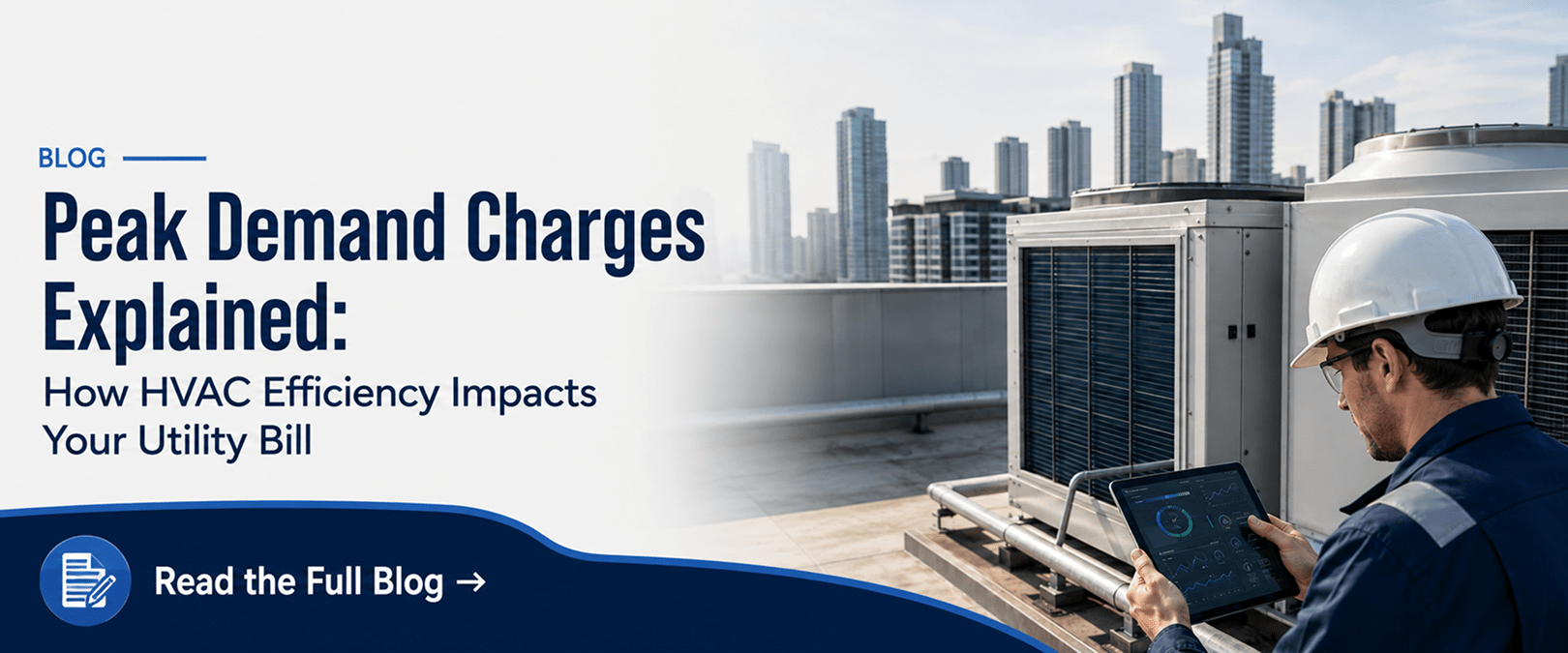
Peak Demand Charges Explained: How HVAC Performance Impacts Commercial Utility Bills
Introduction
The commercial utility bill is determined by several factors, one of which is peak demand charges. This aspect significantly impacts the overall costs, which is why owners and operators of commercial properties need to ensure that their HVAC systems operate at peak efficiency to reduce energy consumption.
Understanding Peak Demand Charges
What Are Peak Demand Charges?
Peak demand is the highest level of power usage during a specific period.
How Utilities Calculate Peak Demand
Peak demand charges are based on the highest amount of electricity used at a specific moment.
Why Demand Charges Matter for Commercial Buildings
The higher the peak demand is, the higher the electricity costs will be.
Why HVAC Systems Have the Biggest Impact on Peak Demand
HVAC as the Largest Energy Consumer
HVAC systems in commercial buildings account for the highest percentage of energy consumption.
Peak Cooling Loads During Summer
HVAC systems require more power to cool the interior of a building during warm seasons.
Simultaneous Equipment Operation
Several units in commercial buildings can often be used at the same time.
How Poor HVAC Performance Increases Utility Bills
Aging and Inefficient Equipment
Older HVAC systems have a reduced efficiency level, which impacts the utility bill negatively.
Deferred Preventive Maintenance
Proper maintenance is crucial for the efficient operation of any heating and air conditioning systems.
Poor Building Controls and Scheduling
Poorly set building controls and schedules can result in significant losses.
Dirty Filters and Restricted Airflow
Restricted airflow results in the system working harder to produce the same amount of cool air.
Improper Equipment Sizing
Equipment that is too big or too small will always operate inefficiently.
Strategies to Reduce Peak Demand Through HVAC Optimization
- Preventive HVAC Maintenance
- Upgrade to High-Efficiency Equipment
- Implement Smart Building Automation Systems
- Optimize HVAC Scheduling
- Improve Building Envelope Performance
- Utilize Demand-Control Ventilation
- Monitor Energy Consumption Continuously
The Role of Building Automation and Energy Management
Real-Time Monitoring and Analytics
Real-time monitoring and analysis help in reducing the peak demand.
Predictive Maintenance
Predictive maintenance prevents unexpected breakdowns and inefficiencies.
Load Shedding and Demand Response Strategies
Load shedding and demand response management can be used to reduce the peak demand.
Industries That Benefit Most from Peak Demand Reductio
Commercial Office Buildings
Commercial office buildings can benefit from peak demand reduction as it lowers the utility bills and improves the comfort of the employees.
Healthcare Facilities
Healthcare facilities require proper heating and air conditioning to ensure the comfort of the patients.
Manufacturing Plants
Manufacturing facilities can benefit from peak demand reduction as it lowers the utility costs and ensures uninterrupted operations.
Retail Centres
Commercial retail centres can benefit from peak demand reduction as it lowers the utility costs and improves the profitability of the retail centre.
Educational Institutions
Educational institutions can benefit from peak demand reduction as it improves the comfort of the students and faculty while reducing the utility costs.
Measuring the Success of Peak Demand Reduction
Peak Demand (kW)
The level of peak demand should be continuously monitored.
Energy Consumption (kWh)
The total energy consumption of the building should also be tracked.
Utility Cost Savings
The cost of electricity should be reduced through peak demand reduction
Equipment Runtime
Equipment run time should be tracked to ensure optimal performance.
Occupant Comfort Metrics
The level of occupant comfort should be measured to ensure that it is adequatetion
Best Practices for Long-Term Utility Cost Management
Conduct Regular Energy Audits
Energy audits should be conducted regularly to ensure optimal performance.
Establish a Preventive Maintenance Program
Preventive maintenance is critical for the optimal performance of any heating and air conditioning system.
Review Utility Bills Regularly
Utility bills should be reviewed regularly to identify potential issues.
Partner with Experienced Commercial HVAC Professionals
Professional contractors can help in reducing the peak demand and optimizing the performance of the building.
Conclusion
Interpretation of peak demand tariffs is critical in the minimization of costs for commercial real estate owners because it allows proactive management of HVAC systems. The implementation of preventive maintenance, automation, and high-efficiency equipment together with ongoing monitoring and analysis of energy consumption will optimize demand, ensure reliability, enhance sustainability, and improve the comfort of occupants.